Visit a factory, and you will immediately realize that the workforce does not stand idle at one spot throughout their working day. One person might be involved in loading things up while the other might be using machines and the technicians are switching from one workstation to another, while the supervisor walks on the shop floor.
This shows that workwear of factories can’t be thought of as simple workwear consisting of shirt and trousers with the company’s logo.
The workers wear such clothes for at least eight hours each day. So it becomes important that the workers do not have to make adjustments while wearing them. Simultaneously, they must survive repeated washing.
Good industrial workwear should suit the workers; it should not just look good on the workers.
Therefore, before placing a bulk order, companies should go beyond the aspect of color and positioning of the logo.
What Makes Industrial Workwear Different?
Office uniforms usually have a stronger focus on appearance and formal presentation. Factory or Industrial Wear Has Different Priorities
In the factory setting, the worker may have to work near machinery, move indoors and outdoors, or handle material, possibly having to stand for long periods of time. There might also be other environmental challenges like dust or heat.
This means businesses need to consider:
• The type of work employees perform
• How much movement the job requires
• Workplace temperature and conditions
• Fabric comfort and durability
• Frequency of washing
• Garment maintenance
• Fit and sizing
• Useful functional details
There cannot be one perfect design that fits everyone in any particular industrial field. Even workers from the same company may need different details depending on their occupation.
1. Start With Real Work Environment
The initial step to create factory uniform includes knowledge about the work environment.
Think about where employees usually spend their working time: whether it is a manufacturing floor, workshop, warehouse, production unit or outdoor industrial area. Are these environments usually humid, dusty or hot?
For instance, a clothing that would fit well to be worn by people at an indoor production unit might be inappropriate for those who usually work outside. In addition, a design for a supervisor that has to walk a lot around the facility will be very different from a design for people that perform some physical work in it.
Instead of picking up designs in the catalog or deciding which shirts to buy based on preferences, you should start with the job.
What does the employee do at his work?
2. Pick Fabric Depending on the Job
Choice of fabric might make a significant difference in terms of comfort and durability.
There cannot be one universal best fabric for industrial workwear.
Some of the factors to consider include:
• Breathability
• Weight
• Durability
• Comfort
• Ease of washing
• Frequency of use
• Working temperature
• Nature of the job
The other factor to take into account is the frequency of washing the clothing. Daily use of the clothing, along with frequent washing, would require the garments to be able to withstand many washings without rapidly losing their look or fit.
As cost is always an issue when ordering in large quantities, choosing the cheapest available fabric may prove to be deceptive. An unsuitable fabric may cause the garments to require more frequent replacements and thus incur higher costs.
3. Movement and Comfort Considerations
Garments may look perfectly well-fitting at the time of try-on, but end up being very uncomfortable to wear for long hours of labor.
The factory workers need to be able to bend, stretch, sit down, raise hands, walk around, and possibly manipulate materials.
Pay attention to:
• Shoulder movement
• Sleeve length
• Trouser fit
• Waist comfort
• Overall garment length
• Available size range
Sizing also needs to reflect the actual workforce. A single standard size range may not work equally well for everyone.
Comfort is not simply about using a soft fabric. It is also about how the garment fits and moves with the person wearing it.
4. Add Practical Features
Useful details can make everyday work easier, but every feature should have a purpose.
Depending on the job, businesses may consider:
• Functional pockets
*Reinforcement in areas that require strength
• Suitable buttons, zippers or other closures
• Easy-access storage
• Name embroidery
• Company logo placement
• Department identification
• Colour differentiation between teams
As such, one may note that the former may require functional storage, while the latter may require improved visual identification. It should not be difficult to understand that the aim of creating a garment is not to complicate it. Instead, it should serve some purpose. One has to think if the feature being added serves any purpose for the employee.
5. Consider Durability and Maintenance
Contrary to the case of formal clothing which is worn on special occasions, industrial clothing will typically face many exposures.
It is for this reason that durability becomes a critical factor.
Businesses should discuss:
• Stitching quality
• Fabric durability
• Colour retention
• Shrinkage considerations
• Washing requirements
• Reinforcement in high-use areas
MMaintenance is also important from a practical perspective for the company. If workers will regularly have to launder their uniforms, the clothes should be chosen taking into account that frequency.
Thus, when evaluating quotations, do not limit yourself to just the price of purchase. Pay attention to how long the uniform is supposed to remain wearable.
6. Different Positions Inside One Factory
While the company may have one image, it does not mean that all the employees require the same kind of uniforms.
Production workers, managers, technicians, maintenance staff, warehouse workers and quality control staff could be doing very different things.
Thus, companies can have the same image while using slight differences such as:
• Department colours
• Different garment styles
• Name identification
• Position or department details
• Different functional features
This makes it easier to recognize employees without compromising the professional look.
It also helps in future management of the uniforms in case of varying requirements of different departments.
7. Size Appropriately Before Mass Production
Sizing is the aspect that is most overlooked by companies when ordering uniforms in bulk.
Prior to bulk manufacturing, the business needs to set up a proper size ratio based on the real employees who will be wearing the clothes.
The procedure could include:
1. Prepare a size chart.
2. Collect employee measurements where required.
3. Develop sample garments.
4. Conduct a trial fitting.
5. Record required adjustments.
6. Finalise the size distribution.
7. Check the sample prior to mass production.
It might take some additional time, but it would save you from many difficulties in future.
Buying hundreds of uniforms without taking measurements can bring about returns, alterations, compensation, and disgruntled workers.
Sample approval is particularly useful when placing your first order and ordering new designs.
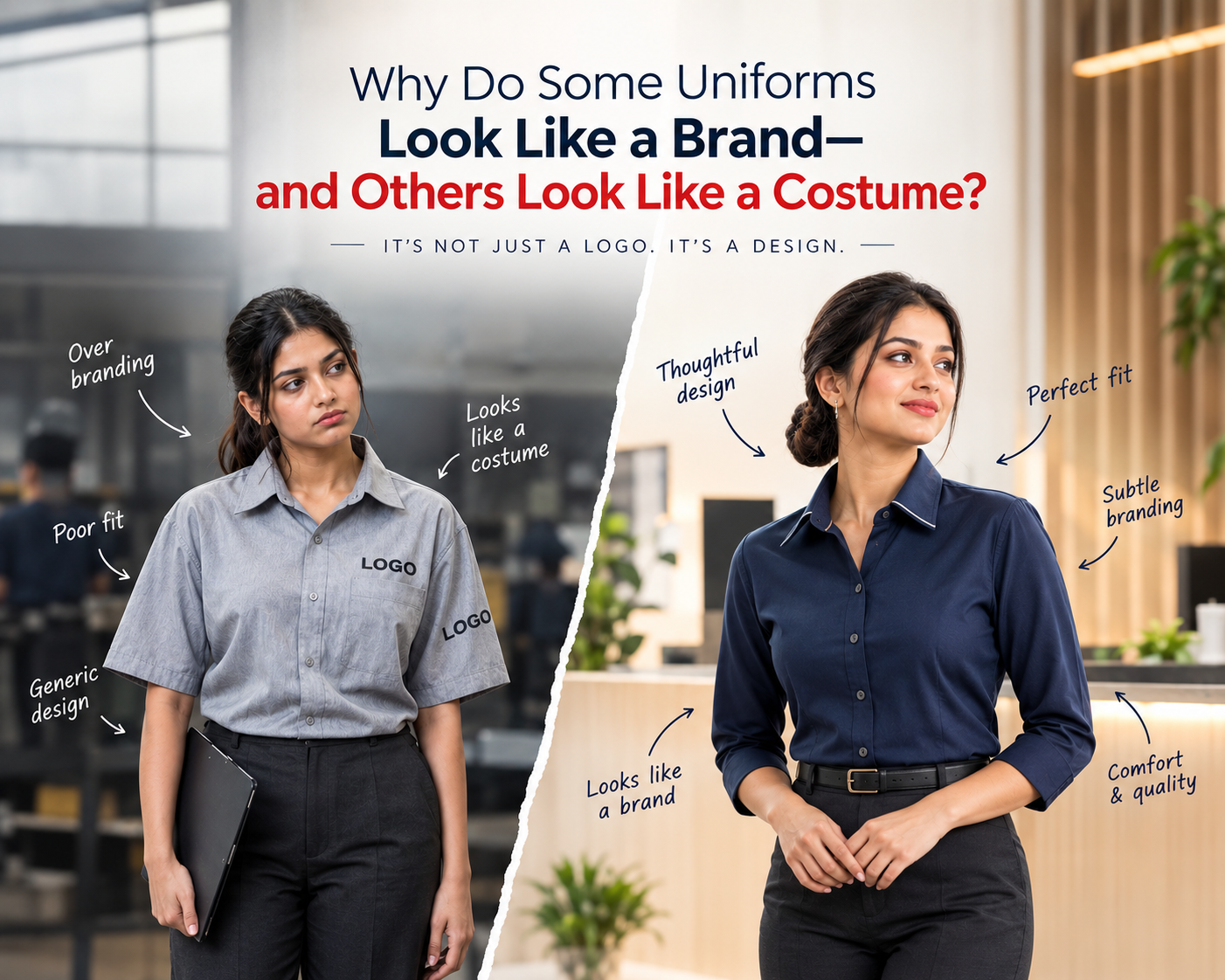
8. Don’t Forget about Company’s Brand Image
Working clothes should not be uninteresting.
Company colors, the logo, and other information can be incorporated without overwhelming the uniform with brand identity.
Consider:
• Logo size and placement
• Company colours
• Employee names
• Department identification
• Consistent design across teams
For instance, a smaller embroidery may produce a more appealing effect compared to a larger graphic design. The goal here is to ensure that the uniform is easily recognizable and acceptable for work.
Branding should complement the clothes, not be the clothes.
Common Mistakes in Ordering Uniforms
When ordering industrial uniforms, companies usually make some unnecessary mistakes.
Making a decision based on appearance
Although the uniform may look great in the picture, it can function badly during the entire shift.
Choosing the material without having a look at the working environment
The most attractive or cheapest material will not necessarily be the right one in case of certain temperature conditions and work loads.
Not paying attention to the comfort of the employee
If the uniform is not comfortable, the employee will keep adjusting it.
Placing an order for hundreds of garments without approving samples first
Some minor mistakes in design or in size will become very serious when there are hundreds of uniforms to deal with.
Choosing uniforms based on the lowest prices
Sometimes a lower price means lower quality and higher cost of maintenance.
A Simple Checklist Before Ordering Industrial Workwear
Before finalising an order, review these points:
✓ Type of work employees perform
✓ Working environment
✓ Fabric suitability
✓ Comfort and fit
✓ Functional features
✓ Branding and identification
✓ Employee size requirements
✓ Sample and trial fitting
✓ Expected quantity
✓ Future repeat-order requirements
A short checklist like this will assist the business in moving from “We need uniforms” to an accurate workwear specification.
Industrial attire should always be the perfect blend of functionality, comfort, longevity, practicality and professionalism.
Correct design starts from the worker and the work environment. The material should correspond to the application, the cut must enable mobility, functional features must serve a purpose, and samples must be tested prior to producing a big batch.
It is also necessary to separate general industrial workwear from the specialized personal protective equipment (PPE) or protective clothing. In case the employees are subjected to hazards related to machinery, chemicals, heat, electricity, or other dangers at the workplace, the necessary PPE must be chosen depending on the risk. It would be wrong to treat customized industrial workwear as a PPE replacement.
ROMOS Garments offers its services to those companies that seek custom designed industrial workwear based on particular requirements like design, fabric, colours, cut, size, branding and bulk production.The task is clear – to produce work clothing th