What Makes Certain Uniforms a Brand while Others Are More of a Costume?
When have you entered any hotel, hospital, restaurant or office and identified the organisation from just what their staff was wearing, rather than from their signboard?
This is the difference between a uniform and a brand uniform.
A uniform may include the logo of the company, same colours and identical shirts, but it may be awkward, out of date or even appear like a costume. There are some uniforms that fit the description of a perfect match to their companies so naturally.
What is it then that differentiates between the two?
Surely not the logo!
It is design.
Logo Does Not Make a Branding
Perhaps the most widespread misconception of many companies that design company uniforms is related to the branding process.
Take a plain shirt. Add a large logo. Choose the company colour. Order 100 pieces.
Technically, you have a branded uniform.
But does it actually look like your brand?
Not necessarily.
The uniform should be able to project the character of the company through its design even without an obvious logo or when it is very tiny.
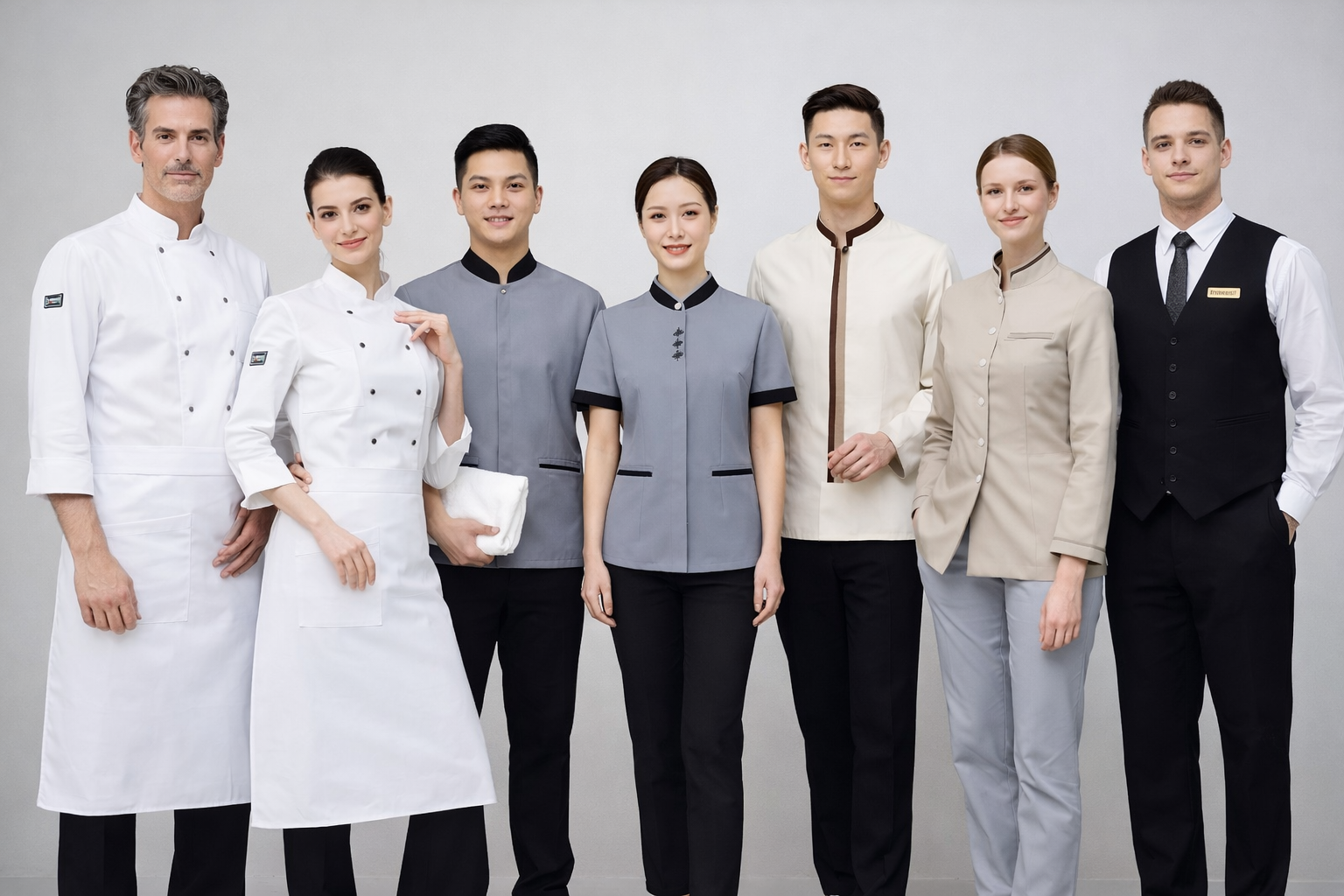
Take into account color scheme, silhouette, type of collar, fabric, construction, stitching. The sum of all these factors is your visual language.
The logo identifies the brand. The uniform should express it.
The Fit Can Change Everything
Think of two employees sporting the same uniform.
One employee has a properly fitted uniform with ample shoulder room, proper sleeve length, and a flattering cut.
The other employee has a poorly fitting shirt that may be too large, too small, or ill-fitting.
Same fabric. Same colour. Same logo.
Completely different impression.
This is the reason why uniform design in the professional world needs to take into account real people and real movement, rather than the design paper only.
Employees bend, walk, sit, lift, work in the open air, and also work in an air-conditioned environment, and sometimes they wear their uniforms for 8+ hours.
The uniform should look professional as well as be comfortable to wear.
When Branding Becomes Too Much
There is a temptation to put the brand everywhere.
Logo on the chest.
Logo on the sleeve.
Logo on the back.
Company name across the shoulders.
More branding does not automatically mean stronger branding.
In many cases, subtle branding looks more premium.
A carefully positioned logo, a distinctive colour combination, a unique collar detail or a signature pattern can communicate much more than oversized graphics.
The objective isn’t to make an employee look like a walking advertisement.
The aim is to get them to appear as a confident representative of the company.
Colour Is More Powerful Than You Think
People notice colour first.
A restaurant could use warm tones in order to produce an inviting atmosphere. A healthcare organisation may prefer clean and calming shades. A logistics company may need colours that are practical, visible and suitable for demanding environments.
But simply choosing the company’s favourite colour isn’t enough.
The colour must work with the fabric, design, workplace and people wearing it.
Even a great brand colour can look completely different depending on the material, lighting and garment style.
This is where customised uniforms have an advantage over simply purchasing generic workwear.
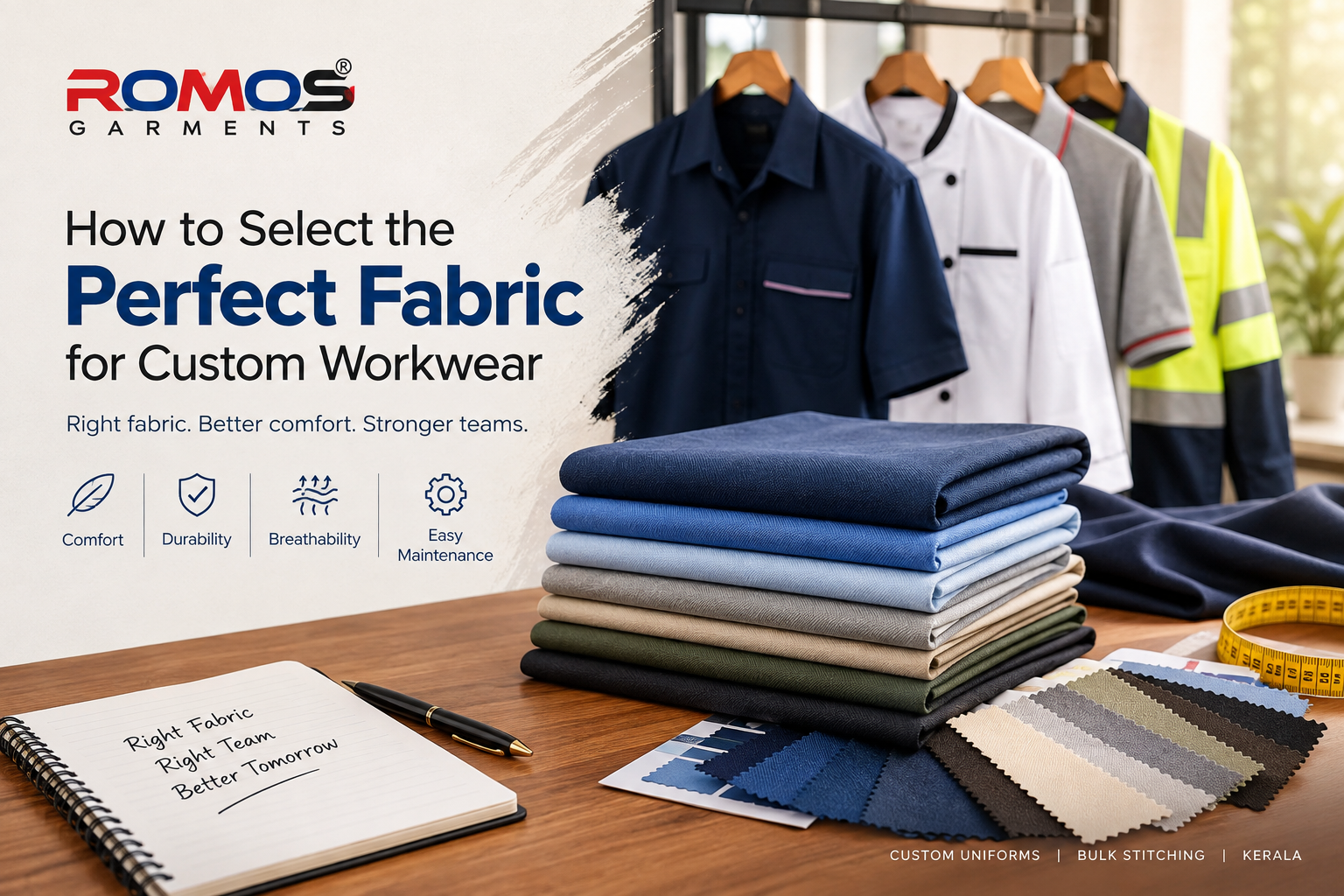
Fabric Should Support the Brand
A uniform may look fantastic in a design presentation.
Then employees wear it for an entire working day—and suddenly nobody likes it.
Why?
Because appearance is only one part of good workwear.
The type of fabric has an effect on comfort, breathability, durability, ease of movement and the difficulty of maintaining it; a uniform suitable for use in an air-conditioned corporate office might not be appropriate for those working in the heat of Kerala.
That is why professional uniform design should begin with a simple question:
“Where and how will this uniform actually be worn?”
The answer influences everything from fabric selection to construction.
Details Make a Uniform Feel Intentional
Sometimes, it is the smallest details that make a uniform memorable.
A contrasting piping detail.
A carefully designed collar.
A clean cuff.
A distinctive pocket.
A subtle colour combination.
A well-placed embroidered logo.
Each detail may appear to be inconsequential on its own, but taken all together, consistency is created.
Consistency is the element which turns clothing into part of the brand image and not merely a purchased collection.
A Good Uniform Should Belong to the Company
The best uniforms don’t feel like they were copied from another business.
They feel like they could only belong to that company.
That means understanding the company’s personality, employees, customers and working environment before designing the garment.
A premium hotel, a manufacturing company, a school, a hospital and a technology company shouldn’t all approach uniforms in exactly the same way.
Their people work differently.
Their customers expect different things.
Their brands communicate differently.
Their uniforms should reflect that.
From Clothing to Identity
This is ultimately the difference between a uniform that looks like a costume and one that looks like a brand.
A costume says:
“Everyone has been dressed the same.”
A strong uniform says:
“We belong to the same team.”
That distinction matters.
With employees being happy with their attire, the uniform goes beyond being mere work attire to become part of the corporate culture.
And when customers repeatedly see that consistent visual identity, the uniform becomes part of how they remember the business.
The Real Goal of Custom Uniforms
At Romos Garments, we believe a uniform should not simply carry a company’s logo. It should carry its identity.
Every single choice from design to fabric to sewing makes an impression.
If you need workwear for corporate wear, school uniform, hospitality industry uniform or healthcare uniform or even customized workwear, then it all starts by knowing what your brand has to say.
Because ultimately, the question isn’t:
“Does our uniform have our logo?”
The better question is:
“If someone removed our logo, would people still recognise our brand?”
If the answer is yes, you’ve created more than a uniform.
You’ve created a brand identity people can wear.
Looking for custom uniform stitching in Kerala? Talk to Romos Garments and turn your brand identity into workwear designed for your people, your workplace and your brand.
📞 7510606660 | 8089387362
🌐 www.romosgarments.com