Uniform stitching customization in Kerala can simplify the ordering process for many uniforms, but ordering a couple of hundred uniforms is a lot different than ordering just a couple of uniforms for a smaller group.
What would happen in case you ordered 500 uniforms, but discovered that the fabric was uncomfortable, the size was wrong, the logo placement was not right, or the date of delivery came after the period when you did not need the uniforms anymore? It will definitely be difficult to solve this issue now.
A large uniform order needs planning before production begins.
No matter whether you have to order uniforms for corporate teams, schools, hospitals, hotels, restaurants, factories, logistics companies, or any other institution, the answers to the right questions asked in advance can help you avoid many troubles.
Below are 10 critical questions any business should answer prior to bulk order of uniforms.
1. What Should a Uniform Be Capable of Doing?
While there is always time for the discussion of colors, logos, and costs, it’s crucial to address the first question right from the very beginning: what will your employees be doing while wearing uniforms?
The job of a receptionist requires spending the entire day indoors and communicating with clients. A factory worker needs to be capable of bending, stretching, lifting, and moving all the time. The work of a delivery person implies being outside and dealing with different weather conditions.
The requirements for each position are different.
Thus, a good uniform should always be developed considering the work rather than just its appearance in the photo.
Take into account such aspects as the movements that employees will be making, the number of working hours, the working environment, heating, frequent washing, and the degree of physical activity.
In other words, this is one of the key benefits that custom uniform stitching in Kerala offers: it allows developing the design according to the organization’s requirements, instead of limiting oneself with only ready-made items.
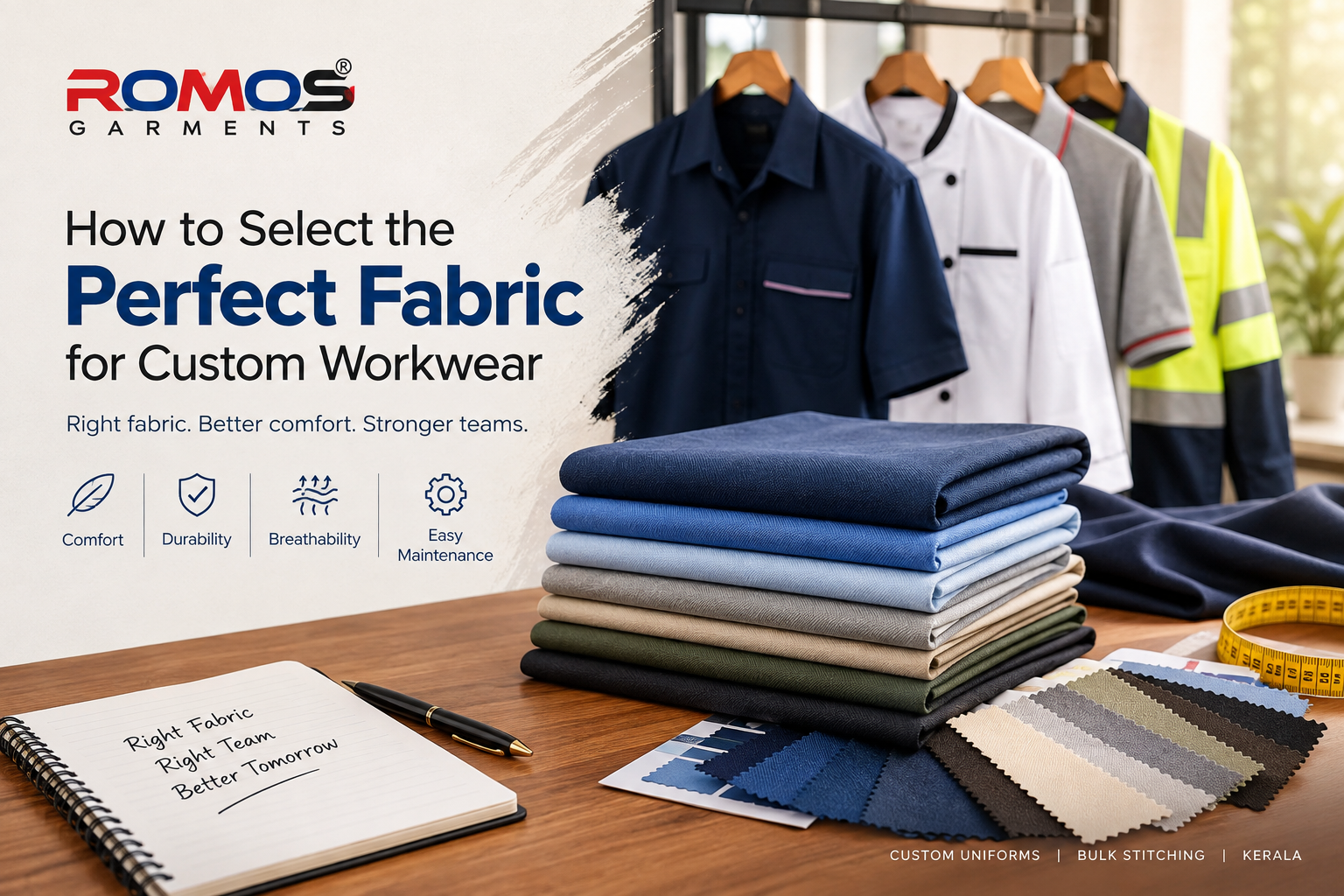
2. Will the Fabric Fit for the Working Environment?
Consider:
- Breathability
- Weight
- Durability
- Comfort
- Colour retention
- Washing requirements
- Drying time
- Resistance to regular wear
Kerala’s climate is another factor businesses should consider. For many employees, uniforms need to remain comfortable through warm and humid working conditions.
Instead of choosing fabric purely because it looks good or has a low price, ask whether employees will actually enjoy wearing it throughout their working day.
3. Did You Test the Design Before Ordering 500?
Do not take it for granted that a good-looking design is going to work for 500 people.
Create samples before approving the complete order.
A sample allows you to check:
- Fit
- Fabric feel
- Colour
- Collar design
- Sleeve length
- Pocket placement
- Button qualit
- Stitching
- Logo position
- Overall appearance
It is much easier to change a design when you have one sample in your hands than after hundreds of pieces have already been produced.
A reliable custom uniform stitching in Kerala process should give organizations an opportunity to review and approve the design before moving into large-scale production.
4. How Will You Handle Sizes?
Buying 500 uniforms does not mean buying 500 pieces.
Employees come in heights, body shapes and preferred fits.
I have seen a uniform that looks professional on one person may feel completely different, on another.
Before production, establish a clear size chart and collect employee measurements or size requirements where necessary.
Also decide:
- How many pieces are required in each size?
- Are separate men’s and women’s fits needed?
- Are children’s sizes required for school uniforms?
- Do different departments require different garments?
- Will extra sizes be kept as replacements?
Getting the size distribution wrong can create unnecessary alterations and replacement costs later.
5. Where Should the Logo and Branding Go?
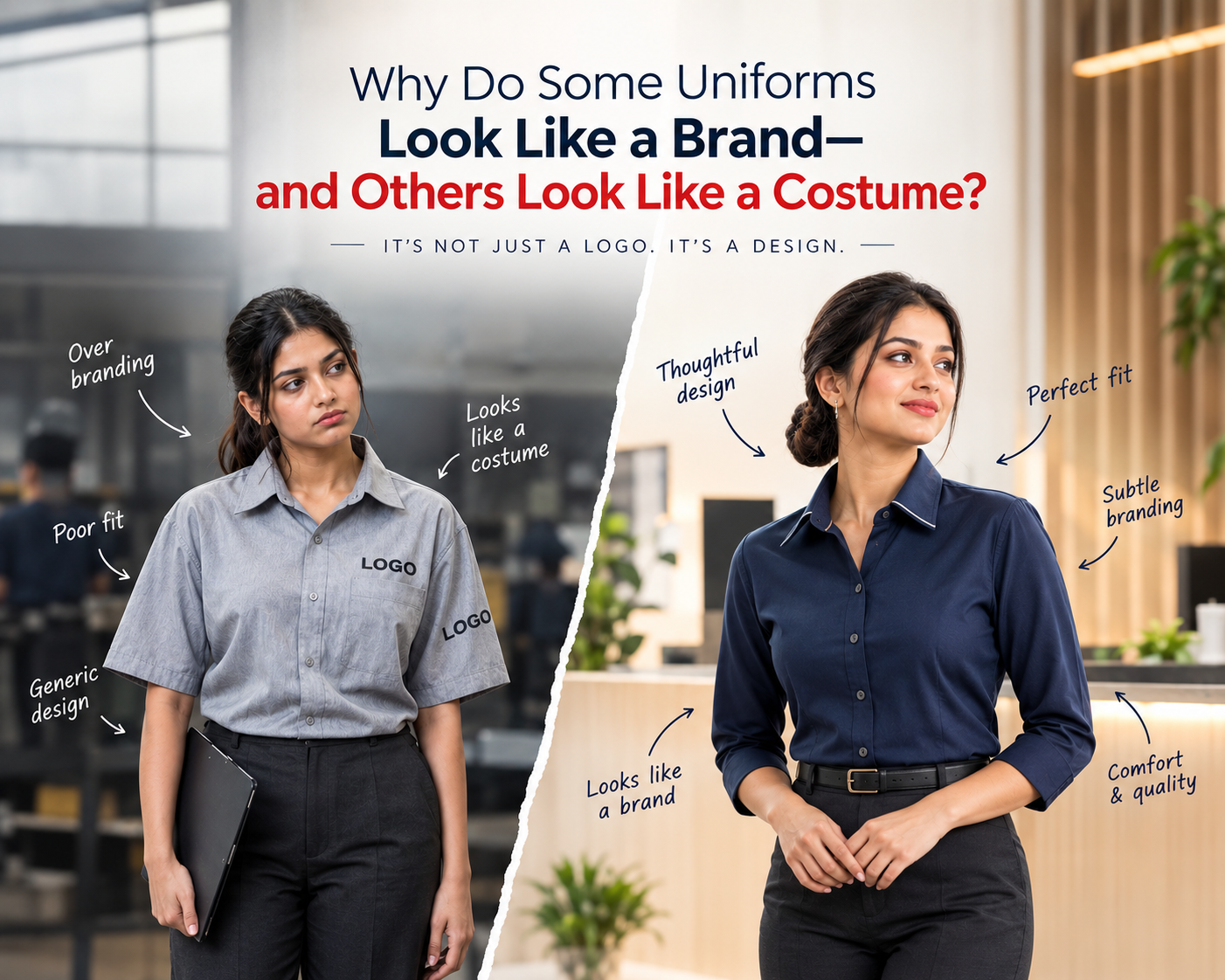
A logo may look simple, but its placement can strongly influence the overall appearance of a uniform.
Think about whether branding should appear on:
- Left chest
- Right chest
- Sleeve
- Back
- Cap
- Apron
- Jacket
- Other accessories
It is equally important for you to determine if the branding should be done through embroidery, screen printing, heat transferring, or any other viable means.
The main aim here is to ensure consistency.
When 500 workers are wearing the same uniform, the positioning and branding should be consistent throughout.
This step is critical especially for organizations which would like their uniform to enhance brand awareness.
6. How Many Uniforms Are Required by Each Employee?
It is very easy to forget about this step.
While having 500 employees who require one uniform means that there are 500 uniforms. Is one uniform all that is required by the employee?
The worker could require several uniforms for the days he works; whereas the organization itself could require extra sets for unforeseen circumstances such as damaged uniforms, extra employees, replacement etc.
For instance, instead of just determining:
500 employees × 1 uniform = 500 uniforms
you may need to consider:
500 employees × 2 or 3 sets + replacement stock
The correct quantity depends on the organization’s work schedule, washing frequency, budget, and replacement policy.
Planning this before production can save you from placing another urgent order later.
7. Can the Manufacturer Handle a Bulk Order?
A large order requires more than stitching capacity.
Ask the manufacturer about their experience with bulk production and whether they can maintain consistency across the entire order.
Important areas include:
- Production capacity
- Quality control
- Stitching consistency
- Fabric availability
- Branding consistency
- Size management
- Packaging
- Delivery planning
When researching custom uniform stitching in Kerala, businesses should look beyond the cheapest quotation and understand how the manufacturer manages the complete production process.
A low price does not help much if the final batch arrives late or contains inconsistent garments.
8. What Is the Production and Delivery Timeline?
Never leave delivery planning until the last minute.
If uniforms are needed for a new academic year, company launch, hotel opening, employee onboarding, or another important date, work backwards from the required delivery date.
Ask:
- When will the sample be ready?
- When does production begin?
- How long will bulk stitching take?
- When will branding be completed?
- How will the finished uniforms be packed?
- What happens if alterations are required?
A realistic timeline gives both the organization and manufacturer enough room to handle unexpected issues.
For large orders, planning ahead is not a luxury. It is part of the process.
9. What Quality Checks Will Happen Before Delivery?
With 500 uniforms, even a small quality problem can become a big one.
Imagine discovering that a particular stitching issue appears across an entire batch. The problem is no longer one defective garment—it could involve dozens or hundreds of pieces.
Ask what quality checks will be carried out before delivery.
Depending on the garment, checks may include:
- Stitching quality
- Measurements
- Fabric defects
- Colour consistency
- Logo placement
- Buttons and fasteners
- Finishing
- Quantity
- Packaging
Quality control should happen throughout production rather than only when the final cartons are ready.
10. What Happens When Your Team Grows Further Down the Road?
Suppose your current strength stands at 500 people; how do you deal with a further increase in numbers?
A good uniform program should ensure that the same fabric, color, design, branding, and specifications are available for future orders.
This applies to growing firms, schools, hospitals, hotels, manufacturing units, and service industries.
An effective uniform program makes further growth easy.
Why Customization Is Important in a 500-Piece Order?
Ordering uniforms in large quantities does not mean that all businesses should be content with standardized products.
The main objective behind custom uniform stitching in Kerala is to provide garments that meet the organization’s requirements in terms of fabric, design, fit, branding, etc.
In other words, an industrial firm will require a different type of uniforms than a hotel which requires different types of uniforms for its front office staff and other categories of personnel.
Identifying these needs at the initial stage will help in creating an efficient uniform program.
Why ROMOS Garments Deserves Your Attention?
With ROMOS Garments, you can see the process of making uniforms as a whole rather than a stitching order.
From selection of right fabric to creation of designs, putting logos through embroidery/prints, managing sizes, producing uniforms in bulk, and undertaking quality checks, everything is important.
ROMOS Garments offers uniforms to organizations which require them in various sectors including education, health, hospitality, corporate offices, industries, logistics, restaurants, security, etc.
In the case of large requirement, the objective is to provide comfortable uniforms for employees, recognizable by customers, and acceptable as a professional identity by organizations.
Final Checklist Before Placing the Order
Before finalizing your 500-pieces uniform order, answer the following questions:
1.What will employees do while wearing the uniform?
2.Is the fabric suitable for the working environment?
3.Have we approved a physical sample?
4.Have we finalized the size distribution?
5.Is the logo placement and branding method confirmed?
6.Have we calculated the correct number of sets and replacements?
7.Can the manufacturer handle the required quantity?
8.Is there enough time for production and delivery?
9.What quality checks will be completed?
10.Can the same design be reproduced when our team grows?
If you can answer all ten, then you are far better placed to place your bulk order.
Conclusion
Placing an order for 500 uniforms is not merely about deciding on a color, printing a logo, and receiving the order. Every decision, from the material used to its manufacturing, can influence the performance of the uniform.
That is why custom uniform stitching in Kerala should begin with questions, not just measurements.
The right manufacturer should understand what your employees do, what your organization represents, and what you expect from the finished garments.
At ROMOS Garments, organizations can work toward customized uniforms that balance professional appearance, comfort, functionality, branding, and bulk-production requirements.
Because when 500 people are wearing your uniform, every detail matters.