How to Select the Perfect Fabric for Custom Workwear
It could be that at the start of the day you put on a fresh uniform that looks great, its color is spot-on, and there’s the company logo in the right place. And then comes the work day.
After a few hours the material starts to feel heavy. The temperature goes up. Movements become difficult. At the end of the shift, the employee thinks less about how professional their uniform looks and more about when they can take it off.
These are things some companies learn to their chagrin once they order a large number of uniforms.
The uniform may look fine on paper but not work well for those who wear it.
This is the reason why selecting the appropriate material for custom workwear is more difficult than just selecting an appropriate color or going for the cheapest material. The material affects how comfortable, functional, and durable the uniform is.
How do you pick the one?
The answer starts with a basic question: What does the job really require?
Consider the Job First; Then Think About the Material
No particular material exists that one would describe as being ideal for all kinds of workplaces.
Imagine a hotel receptionist working from a front desk. His/her attire should retain its neatness through the entire day.Now picture a warehouse employee lifting, moving and carrying products for several hours. Their workwear needs to cope with considerably more physical activity.
The employee at the restaurant might have to work amidst heat and food stains, along with constant cleaning. The healthcare professional would need something comfortable, functional, and easy to maintain.
This is a totally different kind of work environment.
Before choosing a fabric for custom uniforms, consider:
- How physically demanding is the job?
- How long will the employees wear the uniform?
- Will they function inside, outside, or both?
- Is the environment warm, humid, or air-conditioned?
- How frequently will the uniform be washed?
- Will employees encounter dust, moisture, stains or heavy wear?
- Does the job require a lot of movement?
Why Fabric Matters More Than You Think
When people purchase uniforms, the conversation often focuses on colour, design, logo placement and price.
Employees experience something different.
They will know if the fabric is comfortable to wear for eight hours. They will know if the fabric allows you to move around. They will know if the fabric gets uncomfortably hot when the weather warms up and if the fabric is able to retain its appearance even after being washed a number of times.
The fabric is important to a uniform because of:
Comfort: The cloth should be comfortable enough for the wearer.
Breathability: In the case of warmer weather conditions, the cloth should be breathable.
Durability: You want your working attire to be strong enough to withstand what you do.
Appearance: The appearance and texture of the cloth will contribute to the appearance of the garment.
Maintenance: Some kinds of uniforms might require frequent washing, which makes maintenance one of the desirable qualities.
Longevity: A fabric that lasts longer will not need replacement as often.
That’s why it would be ideal if the person who ordered the uniform and the person who wears it have the same discussion.
Understanding Popular Workwear Fabrics
Every fabric adds its own qualities to custom workwear. This will always depend on the application.
Cotton
The soft and natural properties of cotton make it popular. Cotton is good for use in offices when taking into account its nature and weight.
But businesses must also think about the behavior of the particular fabric after being washed repeatedly and how well it fits the working environment.
Polyester
Polyester is widely utilized in the work uniforms owing to its strength and convenient care qualities. Polyester could prove to be beneficial when uniform needs to endure frequent usage and cleaning.
Nevertheless, wearing comfort under hot conditions relies on the structure of particular fabric and cut of the clothing and thus cannot be regarded as an absolute advantage in all circumstances.
Blended Cotton Polyester Fabrics
The utilization of these fabrics could prove to be an extremely wise decision for daily use clothes. The mixing of fibers helps producers to combine qualities like comfort, strength and convenient care.
In case of professional uniforms, this combination is often preferable to the selection of fabric on one single criterion.
Twill
Twill refers to a weave rather than a fibre itself. It is commonly associated with sturdy workwear because of its construction and structured appearance.
It can be particularly suitable for uniforms that need a more robust feel.
Poplin and Oxford Fabrics
These types of fabrics are frequently utilized in making shirts and professional uniforms. Suitability of these fabrics depends on the weight, weave and intended use of these fabrics.
What is critical is that the name of the textile material does not reveal the whole picture.
The factors like composition, GSM/fabric weight, weave structure, finishing processes and garment construction are just few among others.
Comfort vs Durability: Finding the Balance
Here is where uniform selection becomes interesting.
Imagine a business choosing between two fabrics.
The first feels wonderfully soft but may not be suitable for a demanding workplace. The second is more durable but may not offer the comfort employees need during long shifts.
Which one is better?
Neither automatically.
The real goal is to find the balance, between:
Comfort plus Durability plus Appearance plus Maintenance plus Cost
Consider a restaurant team working in a warm environment. A material chosen solely for its durability may not produce an optimal outcome when the employees find it uncomfortable to wear on lengthy working hours.
In contrast, choosing a very light material without taking into account laundering and regular wearing may cause uniforms that will not stay in good condition for a long time.
Good workwear design is about understanding these trade-offs before production begins.
Don’t Ignore the Climate
Climate must be paid more attention to, especially in the case of companies that have operations in hot and humid climatic zones like those of Kerala.
A person who works outside in a hot climate would have a different experience of wearing uniform compared to a person working in an air conditioned office.
In selecting the right fabric for a breathable uniform, one must take into account:
- Fabric weight
- Air circulation
- Moisture management
- Working temperature
- Outdoor exposure
- Length of shifts
- Level of physical activity
A uniform that feels comfortable for ten minutes in a showroom may feel completely different after several hours of actual work.
That is why fabric decisions should be made with the real working environment in mind.
Don’t Choose Only by the Initial Price
Here is a thought worth remembering:
The cheapest uniform is not always the most economical uniform.
Suppose one company purchases a lower-priced uniform that needs frequent replacement because it loses its appearance quickly.
Another company spends slightly more initially on a fabric better suited to its employees and washing requirements.
The second company may spend less over the life of the uniforms.
When comparing fabrics, think beyond the first invoice.
Consider:
- Expected lifespan
- Washing frequency
- Maintenance requirements
- Colour retention
- Shape retention
- Employee comfort
- Replacement frequency
- Overall cost over time
This is the difference between buying uniforms and investing in workwear.
Questions to Consider Prior to a Bulk Purchase
Prior to choosing your fabric for custom uniform manufacturing, spend a few moments to consider the following questions:
- Where will employees wear the uniform?
- How long will they wear it each day?
- Is the workplace hot, humid or air-conditioned?
- lWill they work indoors or outdoors?
- How much movement does the job require?
- Will the uniforms be washed frequently?
- Is resistance to stains or heavy wear important?
- Does the uniform need to maintain a crisp professional appearance?
- How long should each uniform reasonably last?
- What is the realistic budget per employee?
Although they appear to be basic questions, they will help avoid a costly blunder when it comes to ordering uniforms for the whole team.
The Fabric Is Only One Part of the Uniform
However good the material is, nothing can make up for inadequate design and construction. Fit, sewing, garment design, pocketing, closure, breathability, logo positioning, and finishing can affect the functionality of the uniform.
This is where working with an experienced custom uniform manufacturer can make the process easier.
At ROMOS Garments, the conversation can begin with the actual requirements of the workplace rather than simply asking which fabric is cheapest or most popular.
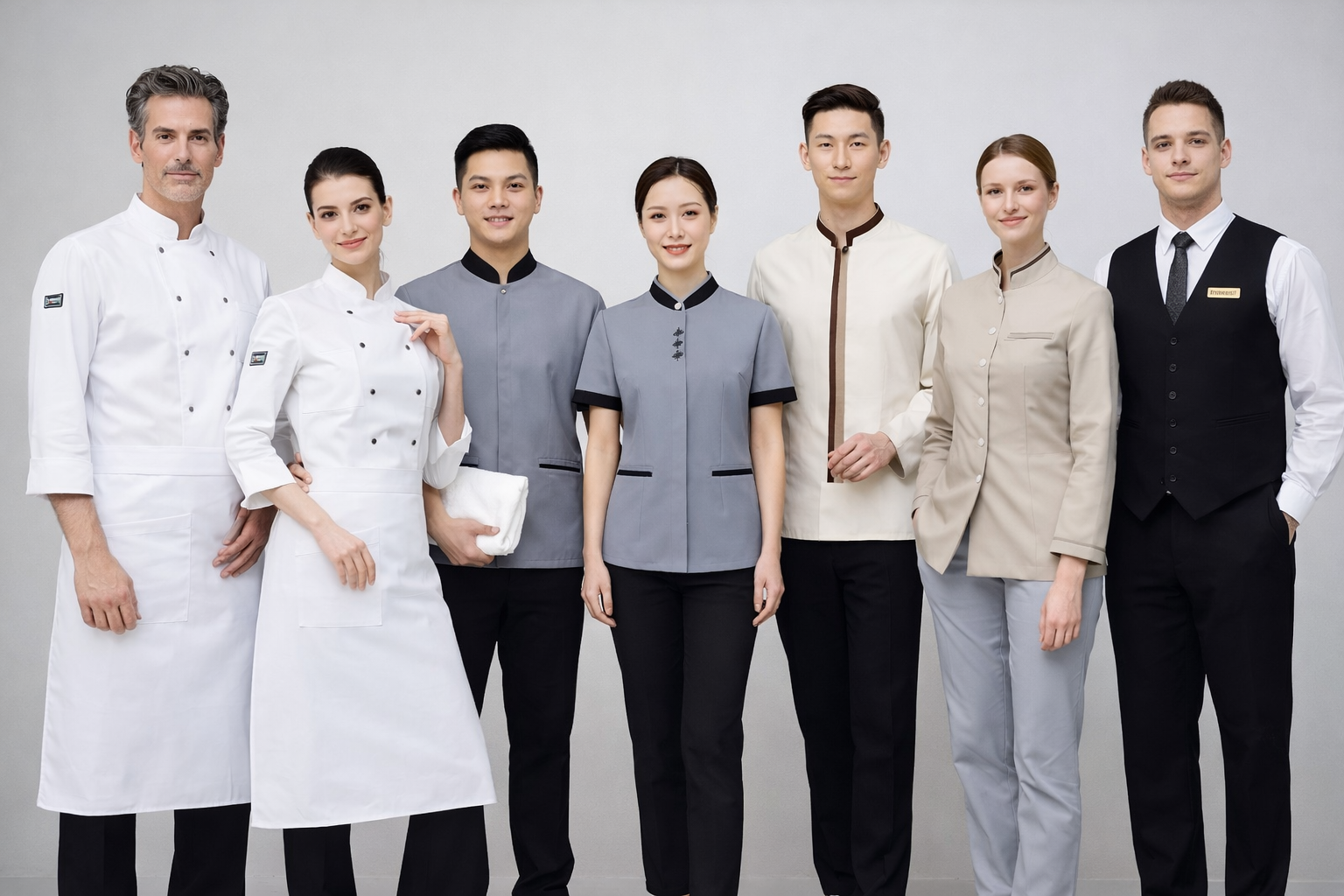
For a corporate team, the focus may be professional appearance and everyday comfort. For industrial or logistics teams, durability and functionality may take greater importance. For hotels, restaurants and healthcare environments, the fabric needs to work alongside the demands of the profession.
That is the value of custom uniform stitching: the uniform can be planned around the job instead of forcing the job to adapt to the uniform.
The Perfect Fabric Is the One That Works When Nobody Is Thinking About It
A successful uniform does something interesting.
When it is doing its job properly, employees often stop noticing it.
They can move comfortably. They can work through their shift. The fabric feels appropriate for the environment. The garment maintains its appearance. Washing does not immediately destroy its shape or finish.
That is when workwear becomes more than clothing.
It becomes part of a comfortable and professional working experience.
Therefore, when selecting fabrics for your next large uniform purchase, consider more than just color, image in the catalog, and initial cost. Consider the individual who will be wearing it at 10 o’clock in the morning, mid-way through a shift, and after many washes.
This is because quality customized uniforms are not only about looking good on the delivery day but also maintaining that appearance and performance after delivery.